









Commentary

Letters: 11/09

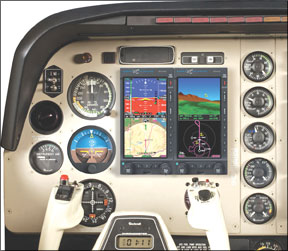
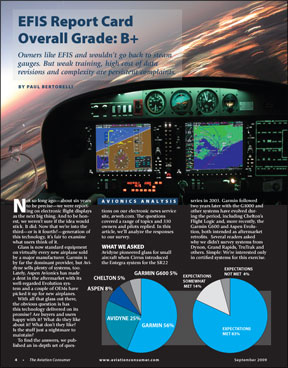
I read with great interest the EFIS article in your September edition. I did not participate in your survey, but feel compelled to comment on my G1000-equipped Diamond DA40. I obtained my private certificate on steam gauges and then purchased my Diamond DA40. After two incidents where I am convinced that my glass cockpit saved my bacon (and that of my CFI), I would never fly steam gauges again. In October of 2007 on approach, while working on my instrument rating, I was descending through 1200 feet on long final at the POH-specified air- speed of 70 knots. ATIS information informed me that surface winds were 7 knots from 250 degrees. I scanned my MFD and thanks to the winds aloft vector on the G1000, I observed that the winds aloft were 37 knots from 040 degrees. I mentioned to my CFI that there would be one heck of a windshear on approach.

Read More »

Letters: 09/09

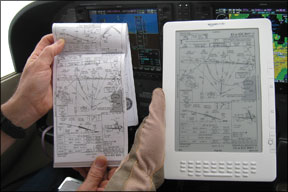
Ive now used the DX (via AirBrief) on a few flights. I find it better than any plate system I have used. Including government plates, Jepp Q service and JeppView on a tablet PC. Page turns are a bit slow and it doesnt have real zoom as you say. I have used both the terminal books and downloaded the airport I was flying to using airbrief.com for the destination airport. The fact that you can get to airbrief.com via the Kindle is great. The single airport PDF reduces the hassle factor significantly.

Read More »

Letters: 07/09

Congratulations on a great article on the 210. Thoroughly enjoyed it. However, one comment caught my eye on page 27 “Owners report…annuals that run around $2500 to $3000.” Sorry, I don’t buy that. In 2003, when I was looking for an aircraft, I purchased a used 1982 TR182. I would rather have had a T210 but, being picky about my maintenance, I was not sure that I could afford to maintain the aircraft properly. I settled happily on the TR182, which has been a great airplane. Since 2003, my annuals have been: These are the out-the-door costs and, by the way, the 2004 and 2008 annuals were owner assists-not Cessna service centers, but reputable mechanics. I believe that what you are showing is the basic shop charge for the annual inspection. I think that this could be very misleading. I suggest that you show total costs for the annual and include the shop basic annual charge if you like. That would give a much more realistic cost of ownership to prospective buyers. If I were to believe those annual numbers, maybe I should have purchased a T210.

Read More »

Letters: 06/09

I enjoyed your article on four-place cruisers in the March 2009 Aviation Consumer. However, I would like to set the record straight on a couple of points and provide another perspective regarding resale values and what defines “best value.” Regarding production volumes of the DA40 versus the SR20, more DA40s have been produced from startup through the end of 2008 than total SR20s through 2008, even though the SR20 has been in production three years longer. Since 2003, the DA40 has outsold the SR20 every year. Here are the statistics to support that. You commented that the purchase price for a comparable used SR20 is generally less than a DA40. As you can see from the numbers above, the higher price of the DA40 cannot be attributed to lower production volume as you supposed as there have been 20 percent more DA40s produced than SR20s. The difference is more likely driven by the markets acknowledgement that the DA40 is an overall better value than the others, resulting in higher demand. Having an airplane retain more of its original value is hardly a negative. Less depreciation equates to a lower overall cost of ownership as owners recapture a larger proportion of their original investment on sale. This factor is often overlooked by prospective owners when evaluating the true cost of owning an airplane. True value is much more than purchase price. Its also operating costs, insurance costs, maintenance costs and investment recapture upon sale.

Read More »

Letters: 05/09

There is absolutely nothing wrong with your evaluation of three landing lights available to general aviation aircraft. (See March 2009 Aviation Consumer.) I think it will be extremely useful to many aircraft owners who have to wonder what the best option for landing lights really is. However, I am writing because I believe that my company, Laminar Flow Systems Inc., has available a Final-Light LED landing light which would have produced quite a different result, if it could have been included in the tests. I am not faulting Aviation Consumer for not including it-the Final-Light is only just now becoming available, although I showed it a Oshkosh a year ago. It comes with an FAA DER approved 8110-3 form included in the $350 to $400 price. Since there is no immediate prospect of a new test happening, I have made a video of a similar test, which included our Final-Light as we’ll as the ones AC tested, and some other combinations. You can see the video at http://snipurl.com/euzla. You can also find it on YouTube by searching “LED Landing Light Test.” I cannot pretend to the impartiality of the Aviation Consumer tests, but I will state that all the lights were tested under the same conditions. I will also be sending Aviation Consumer a Final Light in the hope that you will get a chance to evaluate it soon.

Read More »

Letters: 04/09

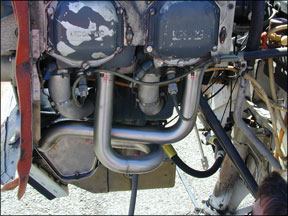
Id like to add some experience to your report on Power Flow exhaust system article in the February 2009 issue. We installed a Power Flow exhaust on our 1976 Cessna 172M about eight years ago. Its been long enough that I cant provide any reliable performance improvement numbers, but what I read in your article is about what we experienced. A significant advantage is the ability to lean more with our Lycoming O-320-E2D. I advise all our pilots to lean aggressively. We installed an engine monitor and discovered that the only engine or flight mode that causes heat problems is high-altitude Vy climb, when the lower density of the air doesnt provide adequate cooling below 70 knots or so. This is at altitudes above the stock service ceiling of the 172.

Read More »

Letters: 03/09

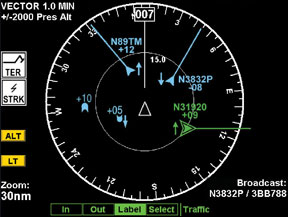
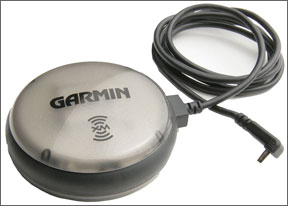
Nice article on the Garmin 330ES. I strongly agree on not jumping to ADS-B technology right now. The FAA is working with an Aviation Rulemaking Committee (ARC) to figure out what to do with the universally opposed ADS-B NPRM from last year. Things could change. If you have a WAAS navigator, the Garmin 330ES is probably the cheapest way to comply with the ADS-B mandate. Add the 330ES and you have “ADS-B out” (which is what is required in the NPRM), plus the 330ES suffices for the transponder that you still have to keep after complying with the NPRM. One thing that keeps getting forgotten with ADS-B is the VFR aircraft or the low-end IFR aircraft. If you don’t have a WAAS navigator-and there is zero reason to spend the money to put one in a VFR aircraft-then you are talking some big bucks to comply with the NPRM with the 330ES. Youll have to get a WAAS navigator and the 330ES, plus installation of a GPS antenna. The 330ES can give you TIS traffic, but it wont give you TIS-B traffic from ADS-B aircraft transmitting their position to you. With the UAT, you can purchase Garmins GDL-90, which includes a WAAS chip and the equipment for sending and receiving ADS-B signals. You still need to keep your transponder unless you buy some kind of display. Nonetheless, complying with the ADS-B-out NPRM would be cheaper with the UAT for the VFR or low-end IFR aircraft, since you don’t have to buy the WAAS navigator.

Read More »

Letters: 02/09

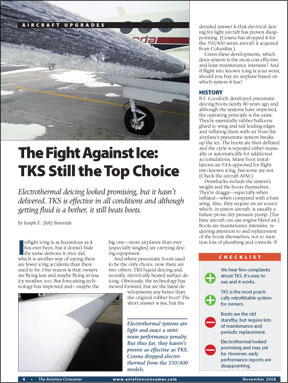
I would like to provide some corrections and clarification to the “Deicing Dissent” letter in the January 2009 issue of the The Aviation Consumer. It is true that the TKS system is not intended to be used as a deice system. However, the correct classification is anti-ice, not ice prevention. The correct usage of any anti-ice system is to activate the protection in anticipation of icing conditions. Surface anti-icing keeps the airframe clear of ice accretion, eliminating the performance loss from pre-activation and inter-cycle ice accretion associated with deice protection systems. This is not to say a TKS system cannot deice the airframe. FAA regulations for known-icing-certificated anti-ice components state that “tests should be conducted that simulate inadvertent icing encounters in which the pilot may not recognize that the airplane is about to enter an icing condition and the anti-ice component may not be activated until actual ice build-up is noticed”. TKS leading-edge panels are required to demonstrate the ability to deice after a two-minute delayed ice accumulation resulting from the most severe icing conditions found in the FAA certification envelope. The modern known-ice certificated TKS ice protection systems now have three fluid flow settings: normal, high and maximum. The maximum setting provides the best deice performance and has a pre-selected two-minute activation mode to eliminate forgetting to turn it off.

Read More »

Letters: 01/09

I just received the November 2008 issue of The Aviation Consumer and read the article on deicing. I have a TKS system on a Mooney 262 (a 231 modified firewall forward to 252 specs). From my experience, don’t trust estimates. The original installation cost was estimated at just over $25,000. By the time we were done, it was over $35,000. This kind of price escalation is nothing new to people with experience in aircraft maintenance and upgrades. More important, I was disappointed in what the article failed to disclose about TKS. Your article clearly pointed out the critical deficiencies of Thermawing and pneumatic boots, but failed to state the TKS is ice prevention and is not deice. While most people and even the manufacturer talk about it as a deice system, it will not deice light rime ice nor will it deice clear ice once it has frozen into the pores.

Read More »

Letters: 12/08

I am a subscriber to Aviation Consumer and ravenously enjoy each issue. I am sure that the Garmin GPSmap696 will receive unmitigated praise, as it probably deserves. I am an owner of a 496 and think it is an excellent product. The 696 seems exponentially better. However, in all the reviews of GPS I have seen, scant attention is paid to the ongoing cost of keeping the databases up to date. The 496 has several different databases-terrain, AOPA data, navigation/Jeppesen and so on. I believe that if a user were to get every update, it would easily cost more than $1000 a year. More alarming is the caveat in the 696 sales literature that if the IFR plates are not kept up to date (every 28 days, I think), they become inaccessible. Putting aside the questionable legality of this marketing approach (no one takes away my printed approach plates when they are outdated), I urge you to explore this issue from a pure cost perspective. Its probably inaccurate to say that the 696 has approach plates-its more truthful to say that it has the ability to display approach plates if one were to incur an ongoing expense of several hundreds of dollars annually.

Read More »

Letters: 11/08

A friend lent me his August issue of Aviation Consumer because he knew Id enjoy reading your article on Tri-Pacers. Actually, I own a 1962 Colt, pretty much stock, although it was recovered for the second time five years ago. The previous recover was in 1973, before I owned it. With fabric still airworthy, my concern, as you pointed out, was what lay beneath it. We actually found very little structural rust and corrosion, so the restoration was a picnic and I enjoy flying it once again. Two things pop out in your article. First is the disparity in the current price range for airworthy Tri-Pacers, which your article stated as between $15,000 and $20,000. Ive been seeing prices between $25,000 and $30,000-plus. A little more research might be in order. Second is the phone number to contact Eleanor Mills, membership officer of the Short Wing Piper Club, who has recently moved to Springfield, Missouri. The number is now 417-883-1457 or e-mail swpn@sbcglobal.net. I heartily recommend the group. Their bimonthly news magazine alone is worth the price of admission.

Read More »

Letters: 10/08

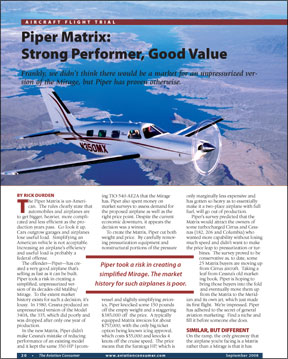
I am very surprised that the Piper Matrix is selling so well. I suppose glitz, fancy new paint and a glass panel supersede the pragmatic need for a very important element: pressurization. The Malibu is relatively slow below 10,000 feet; the wing with its high aspect ratio being designed to shine in the upper teens and flight levels. Piper should have compelled Lycoming to reconfigure its Matrix engine for LOP operations. In my TCM Malibu, I burn 6 GPH less for comparable speed (205 knots) than a Lycoming Mirage. I strongly suspect that Matrix owners, after a year or two of wistfully watching Malibu/Mirages climb above them into on-top blue skies while they bump along in the clouds sucking on the oxygen tube, may come to rue the day they rejected pressurization. Six thousand hours, including 4000 hours in a pressurized Malibu, have told me that I would rather give up flying than go back to a non-pressurized airplane.

Read More »