









Commentary

Letters: January 2012

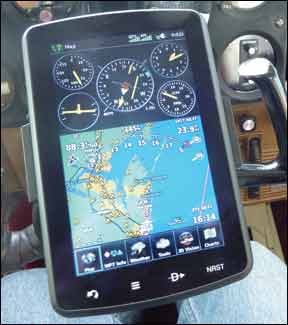
I read your article on navcomms in the December 2011 issue with interest. However, I think there is a bit of a slant toward the all-in-one avionics box with your magazine and I don’t really agree with it. While I admit that glass is wonderful to replace the attitude and heading indicators (electronic HSIs are even better), I’m not a big fan of GPS-only navigation data. GPS can be jammed, even if it hasn’t happened yet. There is no backup to GPS if the system goes down.
Read More »

Letters: November 2011

I watched with great interest your video on the aera 796. Good looking piece of tech for the airplane, but I have a question. Will the unit function as a display-only for charts and plates if for some reason it looses its GPS reception or does it have a display-only function for looking at charts and plates?

Read More »

Letters: September 2011

Re your article on going vacuumless in the June 2011 issue, when I bought my new Columbia 300 in 2002, it came from the factory as a traditional six-pack with a vacuum AI (KI-256). In November 2008, I embarked on an upgrade to the Aspen EFD1000 Pro using Lancaster Avionics in Lancaster, Pennsylvania. (They are awesome.) I chose to install the Mid-Continent Life Saver electric attitude gyro with battery backup as my backup AI. As part of the upgrade, I wanted to remove the vacuum system because it would no longer power any instruments. Initially, we were led to believe that we would be able to remove the vacuum system with local FSDO approval. It turns out this was not possible because the vacuum system is on the type certificate. It had to go through the ACO that controlled the type certificate.

Read More »

Letters: July 2011

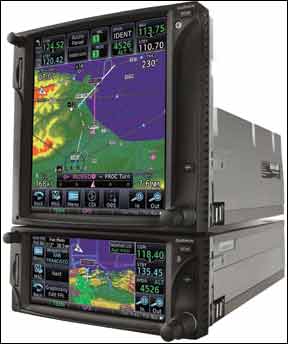
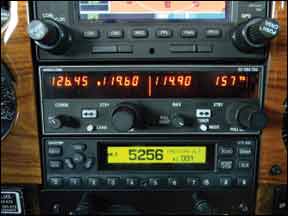
I recently purchased a GTN650 to replace my GNS480. Turns out the STC requires that I have a second GPS/navcomm in order to fly IFR. So I had to go with GTN750, remove the MX20 and SL30 to make room for the 750 and 480. Nobody at Garmin seems to want the public in on this. My avionics tech found out by reading the STC. This applies to composite airframes only. It doesnt make much sense since I have been flying IFR with a single GNS480. Anyway, I had to open the wallet up to the tune of $6000 more, which I was not budgeted for. The PC simulator that comes with the purchase requires quite a bit of RAM and hard drive space to operate. It requires 5GB RAM and 2GB of free disk space. Seems none of my computers have this so Im out of luck.

Read More »

Letters: March 2011

I was interested to read your article on in-the-ear headsets in the February 2011 issue as I converted to an ITE system 3 1/2 years ago. I fly a turbonormalized Cirrus SR22. At Sun-n-Fun 2007 I bought both the Quiet Tech Halo and the Clarity Aloft with the intention of testing them to evaluate them against my Bose headsets. Going into my test I felt the Bose would be superior and the Clarity Aloft would beat the Halo, based on appearances.

Read More »

Letters: February 2011

Sunglasses (see December 2010 Aviation Consumer) are always a great subject. I purchased Veldalo Titanium sunglasses a few years ago after reading about them in Aviation Consumer. This was my first encounter with copper-rose (Blue Blockers) sunglasses and I loved them. They worked best at twilight, amplifying contrast. A problem I had was my glass cockpit displays, which had a washed-out look. I got a pair of free glasses at the last Consumer Electronics show in Las Vegas. While the glasses look funky to my friends, they work great, are comfortable and let me view my glass panel with no problems.

Read More »

Letters: October 2010

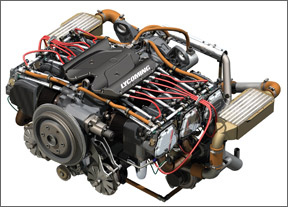
Two articles, plus several letters, in the August issue might be summarized as “electrical vs. mechanical.” The description of the Lycoming IE2 system again raises the question of why most of us are still flying behind antiquated mixture, ignition and engine control systems, when even the most economical compact car sports electronic ignition, fuel injection and variable spark advance.

Read More »

Letters: June 2010

As always, I enjoyed reading Aviation Consumers airplane review of bargain retractables in your April 2010 issue. But having owned both an Arrow and Cardinal RG, you represent the especially efficient Cessna 177RG unfairly. In range, for example, you chart the RG range at 500 miles, which must be the original 1972 50-gallon model. The 1973 RG manuals call for 682 miles, while 1974-1975 models with standard 60-gallon tanks show 821 miles range at 75 percent cruise power. This places the 177RG just behind the Bonanza and Debonair in range capability. Your chart should have at least shown this model variation, if not the maximum, since it purported to include optional fuel.

Read More »

Letters: May 2010

As a retired professor of economics, I cant resist adding to your article on product support in the March 2010 issue. First, all of us realize that producers are in business to make money. Period. No matter how much we might like to believe their warm and fuzzy marketing pieces, without profits, they leave. The fundamental accounting equations: Total revenue minus total cost equals profit. Repairs and support are costs for any producer

Read More »

Letters: April 2010

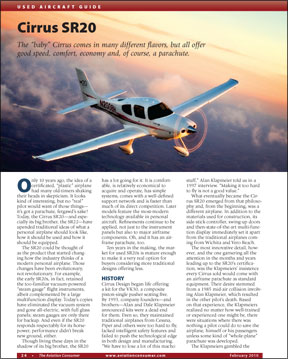
Nice article in the February 2010 issue on the Cirrus SR20. I would like to add some comments/corrections. I own the number two all-electric SR20 (s/n 1269) having taken delivery in January 2003 (boy, was it cold up there then). I have 650 hours on it now and generally have been very pleased with it. You mentioned a $1200 cost for replacement of the reefing cutters every six years. There are two of these and at slightly over $1000 each, its slightly over $2000 to do the job. The number two alternator is a 20-amp B & C unit, same as used on the Bonanza, not the 35-amp unit you referenced. The carbon fiber wing used in the G3 is 50 pounds lighter than the original wing. That, plus the 50-pound increase in gross weight gives you a nice 100-pound increase in useful load.

Read More »

Letters: February 2010

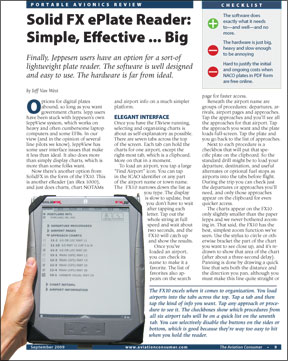
I have read with interest your comments on the SolidFX. (See Aviation Consumer, September 2009.) I was able to see this in person at Oshkosh and would have bought it save the price. I was very impressed by the unit. To me, it seemed fast enough and the zoom feature was very clever and easy to use. However, I did find your comment about the size somewhat confusing. On the one hand, Ive noticed that you complain when the full chart cant be seen (AV8OR ACE, October 2009), and you complain when the unit is large enough to see the whole chart!

Read More »

Letters: 12/09

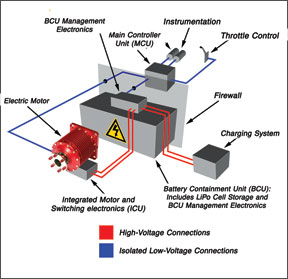
I enjoyed your article on electric airplanes very much, but would like to point out a technical error in the sidebar labeled “Its All About The Batteries.” The author misuses the terms energy and power of the battery. This sounds like a technical nit, but it is the same as confusing tank capacity with fuel flow in discussing a gasoline-powered car or plane. The two metrics are completely unrelated. Energy content of a battery is measured in kWh-kilowatt hours-and corresponds to tank capacity. Power is measured in kilowatts and corresponds to fuel flow, which in turn is related to HP.

Read More »