









Industry News

Letters: July 2010

When the specifications for LSAs were first announced, I was disappointed that there was a maximum gross weight limit. This limit is so restrictive that few LSAs have reasonable useful loads. To be functional, I think a two-seat airplane should have enough carrying capacity to put two adult males and enough fuel for three or four hours flying in them.

Read More »

Engines of Change: Fuels Driving (Or Not)

To visit Lycoming and Continental, as we did last month, is to step into a disconnected world that almost qualifies as an alternate reality. And no, were not resurrecting the hackneyed complaint that the engine companies are out of touch with the wants and needs of their customers. Its the other way around. While the world of piston GA drifts along in business-as-usual mode, the engine makers see a looming cliff defined by the extinction of 100LL and no one is tapping the brakes. Panic may be too strong, but if no universal fuel replacement emerges two years from now, it may be too mild.

Read More »

Rotax Engine Mods: Some Good Options

With more and more Rotax engines out in the field, it makes sense that there is a growing market of aftermarket parts and accessories. However, this is purely good news for owners of Rotax engines on experimental aircraft, including E-LSAs. For owners of S-LSAs-factory complete LSAs not registered as experimental-the usefulness of these parts depends on what it is and which aircraft they own. S-LSAs don’t use the STC process many aircraft owners know and love (or not). Instead, almost any modification can be made with a letter of authorization (LOA) from the aircraft manufacturer. These LOAs are supposed to be issued on an aircraft-by-aircraft basis. So, just because your hangar neighbor with the same LSA has an LOA for a particular change, that doesnt give you the right to do it. That said, the more organized LSA manufacturers keep common LOAs ready to go for customers who request them.

Read More »

Letters: June 2010

As always, I enjoyed reading Aviation Consumers airplane review of bargain retractables in your April 2010 issue. But having owned both an Arrow and Cardinal RG, you represent the especially efficient Cessna 177RG unfairly. In range, for example, you chart the RG range at 500 miles, which must be the original 1972 50-gallon model. The 1973 RG manuals call for 682 miles, while 1974-1975 models with standard 60-gallon tanks show 821 miles range at 75 percent cruise power. This places the 177RG just behind the Bonanza and Debonair in range capability. Your chart should have at least shown this model variation, if not the maximum, since it purported to include optional fuel.

Read More »

First Word: May 2010

I just got a call from a reader in New Jersey who sold his Baron-lucky guy-and wants to step down into an LSA to finish out his flying career. “When you get these things all tricked out with glass,” he said, “they cost $170,000.” That happens to be a significantly larger piece of change than he got for his Baron. Is this right? Or more to the point, do these kinds of prices make for a sustainable LSA industry with dozens of players? The short answer, I think, is no. Let me rephrase that: Prices like that wont sustain the large number of LSA manufacturers now in the market, but my view is that nothing will.

Read More »

LSA Price Trends: Just Too High?

A brief query to the WABAC machine unearthed this gem on light sport aircraft from the Aviation Consumer archive: “Some think the combination of lighter, cheaper airframes and simpler pilot certification will yield a boom in private flying.” We think its reasonable to say that almost everyone thought this, but if you now think the boom sounds more like a faint squeak, you arent alone. The LSA groundswell has yet to form and judging by comments from our readers and video viewers, the cost of the airplanes has something to do with it. Maybe a lot to do with it.

Read More »

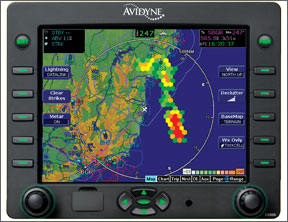
Avidyne EX600: A Great MFD Gets Better

Its interesting to watch brilliantly engineered avionics grow stale.Two years is middle aged for panel gizmos and four years is geriatric. Avidynes popular and feature-rich EX500 is trickle-down technology from the grander EX5000 Entegra MFD. Pilots now demanded more from an MFD than EX500 can offer. Avidynes answer is the EX600. Call it an EX500 on steroids if you want, but we call it a much-needed improvement and a lease on life, perhaps for a year or two. Upgrade pricing from an EX500 is fair, but buying a new EX600 is pricey and installation could be a challenge in tight radio stacks as the bigger EX600 demands more vertical space. Heres a closer look.

Read More »

Letters: May 2010

As a retired professor of economics, I cant resist adding to your article on product support in the March 2010 issue. First, all of us realize that producers are in business to make money. Period. No matter how much we might like to believe their warm and fuzzy marketing pieces, without profits, they leave. The fundamental accounting equations: Total revenue minus total cost equals profit. Repairs and support are costs for any producer

Read More »

First Word: April 2010

Maybe I emit some kind of weird electromagnetic field, but it seems if there’s a way to get a computer to crash, Ill find it. Back in my dot.com, tech-writer days people loved to have me beta test software because Id break it within five minutes. Ive even found bugs in MFDs weeks before certification.

Read More »

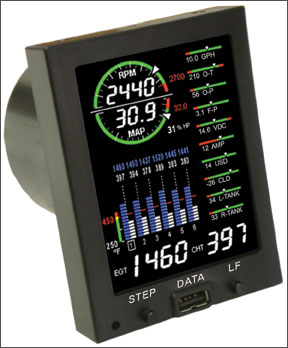
JPI EDM 730/830: Options for Tight Panels

As we attempt to keep our legacy aircraft flying longer and more efficiently, more pilots look to the avionics upgrade path as a means of improving utility and safety. And while the glass-panel primary flight display and multifunction display have both earned their fair share of attention, its also correct to suggest that the combined engine monitor-shorthand for a screen that includes powerplant and airframe system monitoring-is on many owners radar. Who isn’t eager to get rid of those wiggly needles, anyway? J.P. Instruments has been a household name in add-on engine monitors, making popular the bar-graph style of EGT and CHT monitoring. Many pilots are familiar with the firms 2.25-inch gauges and while some of them can include monitoring of other engine parameters besides EGT and CHT, the limited display size reduces the number of items you can watch at once.

Read More »

Bargain Retractables

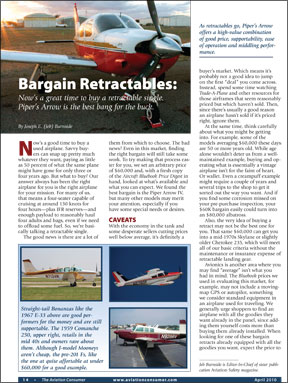
Hows a good time to buy a used airplane. Savvy buyers can snap up pretty much whatever they want, paying as little as 50 percent of what the same plane might have gone for only three or four years ago. But what to buy? Our answer always has been the right airplane for you is the right airplane for your mission. For many of us, that means a four-seater capable of [IMGCAP(1)]cruising at around 130…

Read More »

Letters: April 2010

Nice article in the February 2010 issue on the Cirrus SR20. I would like to add some comments/corrections. I own the number two all-electric SR20 (s/n 1269) having taken delivery in January 2003 (boy, was it cold up there then). I have 650 hours on it now and generally have been very pleased with it. You mentioned a $1200 cost for replacement of the reefing cutters every six years. There are two of these and at slightly over $1000 each, its slightly over $2000 to do the job. The number two alternator is a 20-amp B & C unit, same as used on the Bonanza, not the 35-amp unit you referenced. The carbon fiber wing used in the G3 is 50 pounds lighter than the original wing. That, plus the 50-pound increase in gross weight gives you a nice 100-pound increase in useful load.

Read More »