









Industry News

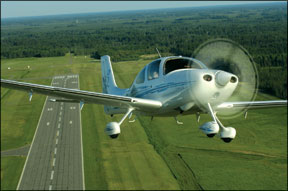
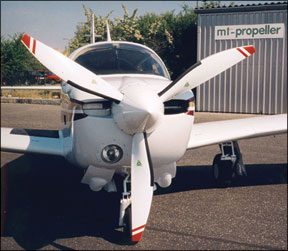
Composite Props: Light and Durable

Composite materials are not news in general aviation applications. Their traditional advantages-less weight, often-greater strength and relative ease in forming complex shapes-are well-known. Those characteristics, coupled with reduced need for skilled labor to, say, build a wing or fuselage when compared to traditional manufacturing methods make them ideal for aviation applications. And, thanks to Cirrus, Diamond and Lancair/Columbia, along with hordes of experimental designers and LSA manufacturers, its the exception these days for a new aircraft design to be constructed entirely from metal. While its not likely we’ll see a non-metallic propeller hub anytime soon, composite prop blades are readily available right now for many engine/airframe combinations and have been for a few years. Both Hartzell and MT Propellers offer composite blades for constant-speed models-MT also offers fixed- and controllable-pitch props-and Sensenich markets a line of ground-adjustable non-metal props for LSAs and experimentals. But, weve been using metal and wood to build props for years: Why go with a composite prop? What benefits do composites offer when made into a propeller and how do the offerings from these three companies differ? How do they compare to wood or metal props, and can you save any money over the long haul by going composite?

Read More »

First Word: 12/09

Those of you keeping score at home might have noticed this is the second sequential issue with a Garmin product in the lead story slot. We generally don’t like to do that, but Garmins new aera line of portables was the big news that needed to come first. I, half jokingly, said to Editor Paul Bertorelli that we were going to start getting letters addressed to The Garmin Consumer. He, only half-jokingly, quipped back, “Yeah, but theyre the only ones innovating.” That statement is both true and false, and quite telling in both ways. Garmins aera isn’t even the second touchscreen portable GPS on the scene. Its more like the fourth, behind Anywhere Maps ATC, and Honeywells AV8TOR and AV8TOR Ace. And if you count Tablet-PC solutions for cockpit GPS navigators, the aera just entered a crowded room.

Read More »

Tecnams Rotax Twin: Budget Performance

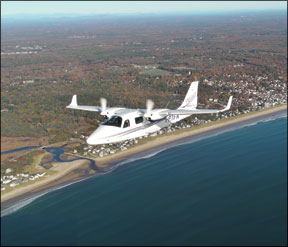
Despite being one of the bigger players in LSA market, Tecnam Aircraft isn’t we’ll known in the U.S. The company has actually been building aircraft and aircraft parts for over 60 years, and has 3000 aircraft flying worldwide. For comparison, Cirrus Aircraft and Diamond Aircraft have each delivered slightly over 4000 airplanes to date. Tecnam is reorganizing in the U.S. with a new website (www.tecnam.net), an expanding dealer and support network and a new aircraft: the Tecnam P2006T light twin. The P2006T (That name doesnt quite roll off the tongue, does it?) has specs more like a single than a twin. Its gross weight is only 2601-50 pounds more than a Cessna 172SP-and cruise speed is in the 140- to 150-knot range. The really novel item is that the P2006T sports two Rotax 912 S3 engines. The S3 is the certified version of the Rotax found in most LSAs. Each engine puts out about 100 HP.

Read More »

Cessna 162 Skycatcher: The Future Alpha Dog LSA

In the wildly edgy television series, The Wire, there’s a classic line for a would-be challenger: “If you come at the King, you best not miss.” Somehow, that seems to apply in the light sport market as a multitude of manufacturers wait and wonder what Cessnas going to do with its Skycatcher LSA. The wait part is over and the wonder soon will be. Cessna is now poised to deliver the first of its 162 Skycatchers by the end of 2009. During 2010, it will ramp up production to begin delivering the first of more than 1000 aircraft it says are on order. We got our first look and demo flight prior to AOPA Summit at Tampa, Florida, in early November. The aircraft presented to us what Cessnas Kirby Ortega called “P1,” or the first production compliant airplane. In other words, what you see is what you get, minus some wiring harnesses left over from last-minute testing. The airplane was built in Wichita, although the entire wing assembly-complete with control surfaces-was built at Cessnas Shenyang, China, contractor. The first production version flew in China in mid-September.

Read More »

Letters: 12/09

I enjoyed your article on electric airplanes very much, but would like to point out a technical error in the sidebar labeled “Its All About The Batteries.” The author misuses the terms energy and power of the battery. This sounds like a technical nit, but it is the same as confusing tank capacity with fuel flow in discussing a gasoline-powered car or plane. The two metrics are completely unrelated. Energy content of a battery is measured in kWh-kilowatt hours-and corresponds to tank capacity. Power is measured in kilowatts and corresponds to fuel flow, which in turn is related to HP.

Read More »

First Word: 11/09

Anyone who makes anything in the aviation business-maybe thats everyone, actually-complains about FAA oversight and regulation. Most of these complaints don’t question the need for regulation, just its execution-FAA foot dragging, ridiculous paper shuffling and inconsistent standards from one office to the next. I have, at times, adopted a more radical view that would allow the free market to regulate general aviation entirely, with little or no FAA intervention. I will be the first to concede that my enthusiasm for Adam Smiths invisible hand has been somewhat diminished by the fact that my retirement savings have declined by 30 percent, thanks to a lack of adult supervision in the banking industry. But I digress in a way which could lead to bitterness and recrimination and, well, who needs that?

Read More »

Cylinder Replacements: Lycoming, ECI Are Tops

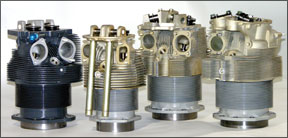
One perennial rite of passage for aircraft owners is what to do about cylinders at overhaul. Whether were talking about top-end work on a mid-time engine, or one we’ll past its published TBO, which cylinders to install can be a major decision. And its not getting any easier. In fact, there’s an element of crisis in the cylinder business. Superior Air Parts was once a major supplier, but is gone from the scene. Continental and ECI have both suffered significant quality issues affecting thousands of cylinders. A recent AD impacts owners of existing Superior cylinders, rendering what was once the cream of the cylinder crop as one-run wonders. One way out of that morass, of course, is to buy a new or factory-rebuilt engine: you’ll get factory jugs. But given Continentals troubles, thats no panacea, either. For those facing top-end work or an overhaul, the choices are more complex. And theyve gotten even harder in recent years given the aforementioned ADs and bulletins. Lycoming owners have it a bit easier: There are no recent ADs against factory cylinders or those supplied by Superior. But anyone with an aftermarket cylinder or flying a Continental engine is probably feeling a little paranoid about all this. After the last three years of ADs, whats going on? Cant anyone make a cylinder anymore? What do engine rebuilders recommend? And what should an owner do when its time to replace one or all of an engines jugs?

Read More »

Skip Holms Bear: Affordable Warbird

If money were no object and you could afford a hangar full of airplanes, would one of them be a warbird, say a P-51 or an F4U Corsair? Probably. Just as likely, the airplane would sit in the hangar, kept airworthy by an expert mechanic, but rarely exercised. Why is that? Its one of the natural laws of vintage aircraft ownership and also one of the reasons the airplane pictured above-the Bear 360-was designed and built. The Bear is, as far as were able to determine, a unique animal indeed: a newly manufactured military-feel aircraft built by a foreign industrial power, formerly a Cold War enemy. Eastern bloc imports like the L-39 and the Yak trainers have similar antecedents, but they arent new and they arent purpose-built to be high-performance fly-for-fun airplanes, which the Bear is. We stumbled upon this airplane at EAA AirVenture this year vaguely thinking we had seen it before (we had), but now the company thats marketing the airplane is taking orders for U.S. deliveries. Interestingly, as new airplanes go, its not especially expensive and as warbirds go, its a mere pittance. At a distance, the Bear looks not unlike its namesake, the Grumman Bearcat, a late World War II Navy fighter thats a relative rarity on the warbird circuit, compared to the P-51, at least. The design springs from famed air racer and combat pilot Skip Holm, who paired with Russian designer Sergey Yakovlev to build a modern, robust military-like aircraft, but with operational costs that don’t envision 60 GPH fuel burns and $100,000 engine overhauls.

Read More »

Letters: 11/09

I read with great interest the EFIS article in your September edition. I did not participate in your survey, but feel compelled to comment on my G1000-equipped Diamond DA40. I obtained my private certificate on steam gauges and then purchased my Diamond DA40. After two incidents where I am convinced that my glass cockpit saved my bacon (and that of my CFI), I would never fly steam gauges again. In October of 2007 on approach, while working on my instrument rating, I was descending through 1200 feet on long final at the POH-specified air- speed of 70 knots. ATIS information informed me that surface winds were 7 knots from 250 degrees. I scanned my MFD and thanks to the winds aloft vector on the G1000, I observed that the winds aloft were 37 knots from 040 degrees. I mentioned to my CFI that there would be one heck of a windshear on approach.

Read More »

First Word: 10/09

People who fly tend to be a bit cultish. We can remain devoted to products we love for the one redeeming value while tolerating the abuse of 100 failings. Were fans. Thats a plus if youre talking new technology. When the real-world operating experience of the Thielert-powered DA42 turned nightmarish, there was outcry and backlash-but there were still devotees. Granted, outside avgas enclaves like the U.S., customers will put up with quite a bit to burn diesel. For some its go diesel or go bankrupt, sooner or later.Diamond Aircraft is now staking a hefty piece of the bank that they can win back and gain fans by reinventing the aerodiesel on their own as the Austro. The Austro is not a shined-up Thielert (now Centurion) engine. Its built on the same bones, but its construction is beefier. Aviaton Consumers editor, Paul Bertorelli spent some time poking around that engine at the Diamond factory in London, Ontario. His impression is that that Austro believes that Thielert modified the original Mercedes block, head and injection system in ways that reduced durability. Modern, over-the-road diesel engines have head bolts as big as your fist a for a reason. Diesels pound the hell out of themselves and everything theyre attached to. Heavy structure isn’t an option you can skimp on.

Read More »

Rotax Owner Survey: Overall, Top Marks

Despite the company having been around for some 90 years, powering an aircraft with a Rotax engine is something relatively new to most general aviation pilots in North America. Until the onslaught of light sport aircraft began five years ago, many had never even heard of a Rotax engine, despite their popularity and penetration in the power sport markets (motorcycles, snowmobiles, ATVs, personal watercraft and so on). As a result, these days its likely an ultralight, experimental or LSA you own or plan to fly is powered by a Rotax engine, part of Canada-based Bombardier Recreational Products Inc. That high level of market penetration means more and more Rotax engines are in service. Because of their increasing popularity, we wanted to find out about owners experiences with them, including maintenance frequency, factory support and overall costs of ownership. To find those answers, we crafted a 13-question ownership survey and made it available through our online sister publication, www.avweb.com, in early September. The results show owners are generally happy with their engines, and most maintenance issues are easily handled. But finding someone to work on them at an out-of-the-way location might be a challenge. Thankfully, the Rotax dealer network appears to be meeting owners needs, and those flying in the experimental category generally find the engines to be easy enough to work on themselves.

Read More »

Letters: 10/09

We were pleased that Jeff Van West liked Version One of the FXVIEW software. However, we felt that most of the article was fair, there are some misleading points we would like the opportunity to clarify.The FX10 is only one ounce heavier and one inch wider than the Kindle DX but it has about 14 percent more display area. Some of our customers tell us they would prefer an even larger device. While pleased that Van West liked the zoom and pan functionality we were surprised that he did not see a use for it. Being able to zoom in on a briefing strip, missed approach procedure, or small text boxes can significantly reduce the need to rely on reading glasses for those of us (myself included) with aging vision. There are also many Jeppesen charts in a two-page format. While the unit and FXVIEW software is not inexpensive, the price is set to support a viable business model that can support customers, provide functionality enhancements, and bring new products to market. We cannot apologize for having a business plan that allows us to employ the best, be viable and provide a return on investment. The landscape is littered with bankrupt aviation ventures that promise too much for too little.

Read More »